

Pogačar Tour dominance has already become the defining story of the 2026 Tour de France. After stage 6, the race has taken on a familiar shape: one overwhelming favourite far ahead, and his rivals recalibrating their ambitions.
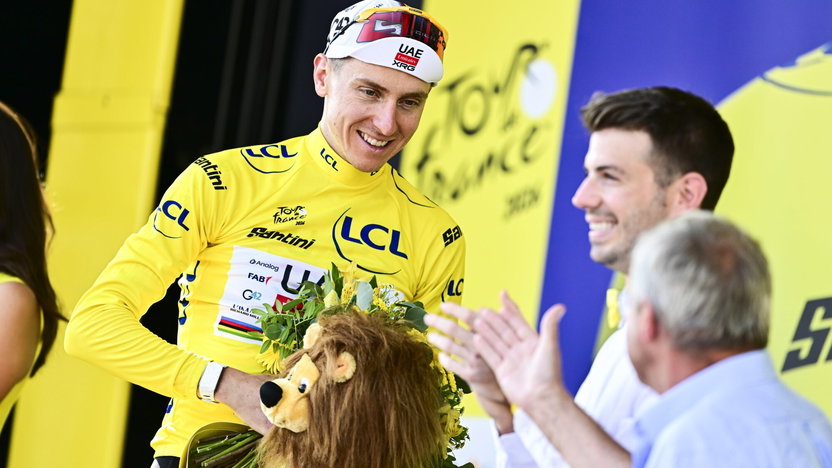
Tadej Pogačar’s attack over the Tourmalet left Jonas Vingegaard 2:42 down overall. The move also changed the mood of the race. The Tour had not reached its deeper mountain schedule, yet suspense around yellow had already thinned.
That pattern feels modern because Pogačar is modern. Yet the Tour has seen this kind of control before. Saturday’s hot run through the Dordogne to Bergerac recalled one of the clearest examples.
Pogačar Tour dominance follows an old Tour pattern
In 1994, Miguel Induráin arrived at the Bergerac time trial under pressure from Tony Rominger. The Swiss rider had won a third straight Vuelta a España and had pushed Induráin late at the previous Tour.
The 64km stage 9 time trial ended that optimism. Induráin took exactly two minutes from Rominger and more than four minutes from every other rider. The mountains had not started, but the race already looked settled.
Spanish newspapers celebrated with the pun “Tirano de Bergerac.” Induráin then extended his advantage across two Pyrenean days. By Luz Ardiden, he led Rominger by just under eight minutes.
Rominger later abandoned on the road to Albi, ill and demoralised. Marco Pantani animated the Alps, but the yellow jersey contest had effectively ended in Bergerac.
Induráin’s five Tour wins often followed that script. His time trial power and some conservative route designs decided the race early. The first time trial, or first major summit finish, often created the decisive separation.
Lance Armstrong’s since-rescinded Tour wins largely used the same structure. Team Sky also often built large first-week advantages during its period of July control.
The approach reaches further back. Jacques Anquetil did not invent early control, but he perfected it in the 1960s. Tour dominators have repeatedly tried to establish a lead, then make resistance feel pointless.
Tourmalet attack leaves rivals racing a different contest
Pogačar has now applied a similar principle with different tools. His long-range attacks can look impulsive, but they follow clear logic. They remove tactical complications and replace them with a test of raw power.
That was the story on the Tourmalet. UAE Team Emirates-XRG knew Pogačar would likely be strongest uphill. They also calculated he could descend faster than Vingegaard, then keep gaining on the shallower climb to Gavarnie-Gèdre.
For this version of Pogačar, the attack was less gamble than calculated route to victory. Once he opened the right gap, his rivals faced a familiar problem. They had to decide whether to chase yellow or defend second place.
Before the race, there were reasons to expect a contest. Vingegaard had won the Giro d’Italia. Remco Evenepoel had joined Red Bull-Bora-Hansgrohe. Paul Seixas began his debut with attention on his three-week potential.
Those storylines may still hold value. Yet Pogačar’s level has placed him in a separate competitive space. Even the strongest versions of his main rivals were always facing a severe challenge.
ASO defends early Pyrenees after Tourmalet blow
Pogačar’s lead has placed ASO’s 2026 route under scrutiny. Technical director Thierry Gouvenou has defended the decision to use an early Pyrenean test after the Barcelona Grand Départ.
Gouvenou told TV2 that the issue was not the route, but “the difference between Pogačar and the others.” He also rejected bypassing the Pyrenees, saying that would compromise the race’s sporting challenge and identity.
History supports part of that argument. In 1992, the Tour started in San Sebastian and largely avoided the Pyrenees. Induráin still crushed the field in the stage 9 time trial in Luxembourg.
The 2023 Tour offers another contrast. After a Bilbao Grand Départ, the race used two demanding Pyrenean stages in the opening week. Vingegaard gained a minute on Pogačar at Laruns, before Pogačar responded at Cauterets.
Three years later, that rivalry has shifted heavily toward Pogačar. ASO presented the 2026 route last October as a Tour “in crescendo.” After the Tourmalet, that claim sounds far less convincing.
The broader question is whether the modern Tour tries too hard to create daily drama. During the Induráin era, the course often centred on a small number of decisive general classification days. Time trials and mountain stages sat among bunch sprints and transition stages.
Modern Tours under Christian Prudhomme rarely allow that much downtime. The race seeks tension, cliffhangers and daily talking points. That approach worked brilliantly when Pogačar and Vingegaard were almost evenly matched in 2022 and 2023.
Pogačar’s current superiority may force another rethink. A 1990s-style route could create different problems for him. A long early time trial might allow Evenepoel to build a large lead, leaving Pogačar fewer mountain days to respond.
Still, the central lesson remains uncomfortable for route planners. The riders make the Tour, and some riders make it feel decided early. On current evidence, Pogačar would likely find a winning path through almost any modern route.