

Tadej Pogačar still commands the Tour de France, but the UAE illness crisis has changed the race’s tone. After Thursday’s Alpine stage to Orcières-Merlette, the yellow jersey remains 4:32 ahead of Remco Evenepoel.
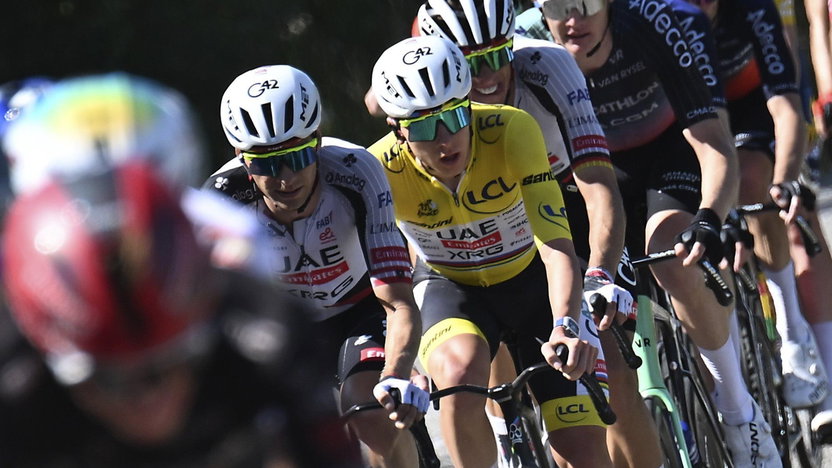
His advantage is large, yet his team’s condition now looks far less secure. UAE Team Emirates-XRG reached the first of three consecutive Alpine days with several riders visibly struggling.
UAE illness crisis follows first Alpine warning
Orcières-Merlette carries heavy Tour history. In 1971, Luis Ocaña briefly overthrew Eddy Merckx there before crashing days later on the Col de Menté.
No such rebellion came on Thursday. Pogačar’s main rivals finished with him, despite his limited support on the final climb.
By then, Brandon McNulty had already left the Tour after struggling on the opening climb. Adam Yates also lost significant time for a second straight day.
Yates finished more than 28 minutes down. Tim Wellens only narrowly avoided elimination, arriving more than 43 minutes behind stage winner Richard Carapaz.
That performance contrasted sharply with UAE’s earlier dominance. On stage 6 to Gavarnie-Gèdre, Felix Grossschartner, McNulty, Yates and Isaac del Toro helped destroy the GC group on the Col du Tourmalet.
Pogačar then attacked decisively. His later solo victories at Le Lioran and Le Markstein pushed the race further away from his opponents.
Jonas Vingegaard’s abandon on stage 15 appeared to remove the Tour’s main remaining threat. The two-time winner had started in Barcelona as Pogačar’s clearest rival for yellow in Paris.
Evenepoel has since presented second overall as his realistic target. He repeated that stance after beating Pogačar in the stage 16 time trial.
Thursday’s finale supported that view. Even without a full UAE train, Evenepoel did not attack the race leader.
Maxim Van Gils and Jai Hindley instead rode a controlled tempo for Red Bull. Their pacing protected Evenepoel’s position rather than testing Pogačar.
Van Gils later told Sporza the stage win was already gone. He said the team did not want to waste energy chasing tenth place and seconds.
The climb also limited tactical ambition. Orcières-Merlette averages 6.7%, and a large GC group contested the finish there in 2020.
Paul Seixas of Decathlon CMA GCM told L’Équipe that conserving energy mattered most. He expects the next two days to shape the podium battle.
Alpe d’Huez stages may test weakened UAE
Pogačar leads Evenepoel by 4:32 and Seixas by 7:11. Still, the next terrain can punish any rider suffering through illness or fatigue.
If Vingegaard were still racing, he likely would have probed UAE immediately. It remains uncertain whether Evenepoel or Seixas will do the same.
Evenepoel told Sporza he would not take reckless risks that threaten second place. He also suggested Decathlon may attack Del Toro’s third place.
Seixas sits 20 seconds behind Del Toro in that fight. Evenepoel said that battle could reveal whether Del Toro is also affected by illness.
UAE’s ability to control early racing now appears reduced. Through the first two weeks, the team often shut down breakaway threats with authority.
Friday’s stage could begin very differently. The route includes the Col Bayard and Col du Noyer before the first Alpe d’Huez summit finish.
Pogačar acknowledged UAE must conserve energy. He said the team would try to survive the stage before reaching Alpe d’Huez.
UAE insist Pogačar has not been affected by illness. His individual strength remains the central fact of this Tour.
Sports manager Matxin Joxean Fernandez also struck a calm tone at Orcières-Merlette. He said there is a solution to every problem.
However, McNulty is out, Yates and Wellens appear ill, and Florian Vermeersch is carrying an injury. That leaves Pogačar with a thinner shield.
The Col du Noyer adds another historical layer. Ocaña launched his famous 1971 move there, and the climb arrives early on Friday.
Pogačar has answered every major question in this Tour so far. But his rivals will watch closely if the UAE illness crisis creates another opening.