

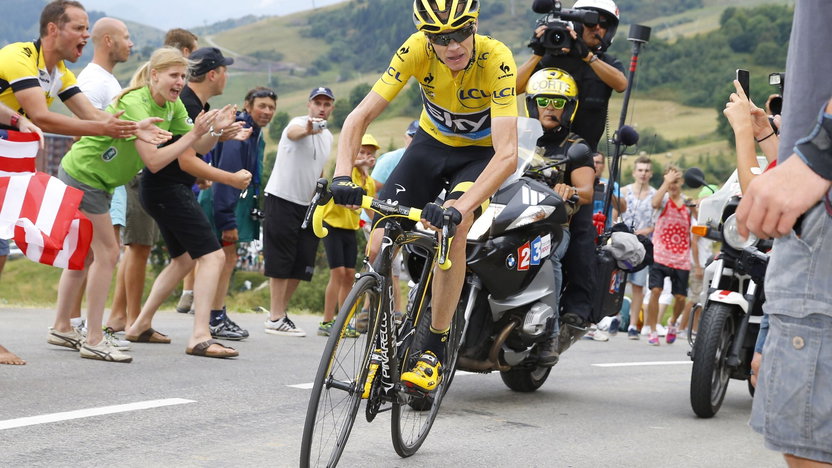
The Chris Froome legacy is unlike almost any other in modern cycling. His retirement closes a career of towering Grand Tour success, fierce scrutiny, and a painful final chapter.
Froome remained a professional until the end of 2025. Yet his time as a Grand Tour contender effectively ended on June 13, 2019.
That day, he crashed while reconnoitring the Critérium du Dauphiné time trial. A gust caught his front wheel after he lifted his hands from the bars.
Before the crash, Froome was a leading favourite for a fifth Tour de France title. That would have matched the race record.
Instead, he suffered injuries that changed his career. He broke both femurs, an elbow, vertebrae, and his sternum. He also suffered a collapsed lung.
Froome spent more than a week in intensive care. At 34, many assumed the crash would end his career.
Chris Froome legacy shaped by dominance and decline
Froome did not accept that conclusion. He returned to racing the following February at the UAE Tour.
The COVID-19 shutdown soon paused the season. That delay appeared to offer more time for rehabilitation.
But Froome never regained his old level. Ineos left him out of their Tour de France selection when racing resumed.
Sylvan Adams then offered Froome a lucrative five-year deal to lead Israel Start-Up Nation. Ineos did not block the move.
The transfer began with optimism. It ended with Froome increasingly peripheral at Israel-Premier Tech.
He raced the Tour in his first two seasons with the team. Those appearances showed his resolve more than his competitiveness.
In 2021, he finished 133rd overall. That remains the lowest finish by a previous Tour de France winner.
There was one notable flash in 2022. Froome joined the early break and finished third on Alpe d’Huez.
That result became the high point of his Israel-Premier Tech years. He did not ride a Grand Tour in his final three seasons.
He also did not win a race in the final seven seasons of his career. His last years played out mostly in smaller races.
Seven Grand Tours and a rare place in cycling history
Froome’s late decline should not obscure his record. Statistically, he ranks among the greatest Grand Tour riders.
He is one of eight men to win all three Grand Tours. Only Eddy Merckx, Bernard Hinault, and Jacques Anquetil have more Grand Tour wins.
Froome won seven in total. His tally includes four Tours de France, the 2018 Giro d’Italia, and two Vueltas a España.
He won the 2017 Vuelta on the road. He also received the 2011 Vuelta title after Juan José Cobo was caught by the biological passport.
His path to that status was unusual. Born in Kenya and schooled in South Africa, he emerged from African cycling.
He later represented Britain after changing allegiance at the start of his professional career. That move helped his path to Team Sky in 2010.
Even then, stardom was far from certain. Sky did not select him for the Tour in his first two seasons.
He also had no contract offer for 2012 before his breakthrough at the 2011 Vuelta. That race transformed his trajectory.
The following year brought tension with Bradley Wiggins at the Tour. Froome looked stronger in the high mountains.
Yet Wiggins remained Team Sky’s chosen leader. Froome accepted that hierarchy, then became team leader the next year.
Recognition never matched the record
Froome’s achievements surpassed those of every other British cyclist by Grand Tour count. Still, British recognition often lagged behind.
The BBC Sports Personality of the Year record showed that gap clearly. Froome was shortlisted three times.
He never finished higher than sixth in the public vote. Tom Simpson, Chris Hoy, Mark Cavendish, Bradley Wiggins, and Geraint Thomas all won the award.
Froome’s global background partly shaped that reception. Many viewed him as a citizen of the world rather than a conventional British sporting figure.
His wider reputation also reflected the Team Sky era. Sky aimed to produce a clean British Tour de France winner.
But the team’s handling of transparency and criticism divided the sport. Froome won in the shadow of Lance Armstrong’s downfall.
That timing brought intense scrutiny. Dave Brailsford and Sky often responded defensively to questioning.
Froome usually handled public pressure differently. In press conferences, he remained calm, careful, and polite under difficult questioning.
He also endured roadside hostility while keeping his emotions mostly contained. That restraint became part of his public image.
In 2017, the Jiffy Bag affair placed pressure on Team Sky. Froome was slow to offer public support for Brailsford.
Later that year, he returned a positive test for salbutamol during his Vuelta victory. The case posed a major threat to the team.
Froome resisted calls to stop racing while his defence took shape. He then won the 2018 Giro in extraordinary fashion.
For much of that race, Simon Yates and Tom Dumoulin looked central to the contest. Froome seemed below his best.
He won on the Zoncolan, then almost cracked on the road to Sappada. Before stage 19, he sat fourth overall, 3:22 behind Yates.
His attack on the gravel of the Colle delle Finestre came with 80km remaining. It initially looked desperate.
Instead, Froome won by three minutes at Bardonecchia and took the maglia rosa. George Bennett famously called it, “He did a Landis, Jesus.”
That ride remains the defining moment of Froome’s career. It also captures the complicated nature of his legacy.
Froome’s racing style rarely drew romantic praise. His position looked awkward, and his pedalling seemed forceful rather than elegant.
Team Sky often controlled races through long tempo efforts before Froome attacked on the final climb. Critics found the formula stifling.
Yet the numbers are immense. The resilience after 2019 was also real, even when results vanished.
The Chris Froome legacy will rest on both truths. He dominated the Grand Tours, then endured a long, public loss of power.
Few champions have left the sport so gradually. Fewer still have carried such a strange mix of glory, doubt, and persistence.
For additional reporting, see www.domestiquecycling.com.