

A French judge authorised nighttime doping controls involving Tadej Pogačar and Jonas Vingegaard at the Tour de France, L’Équipe reported.
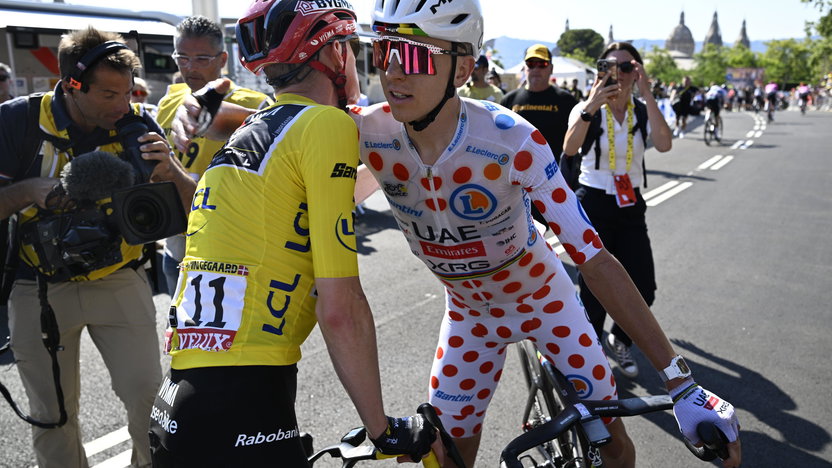
The controls took place during the night of 18 to 19 July. Vingegaard was reportedly tested around 2:00 a.m. Pogačar received a visit roughly three hours later.
According to L’Équipe, the order followed an application from the International Testing Agency, known as the ITA.
A liberty and custody judge at the Paris Judicial Court approved the measures under a rarely used French legal procedure.
Legal threshold for nighttime doping controls
L’Équipe reported that Article L.232-14-4 of French sports law governed the application. The provision requires a high statutory threshold before any order.
Under that article, a judge must find that legal conditions have been met. They include “serious and consistent suspicions” of an anti-doping rule violation.
The law also requires a risk that evidence could otherwise be lost, according to L’Équipe’s account of the provision.
The judicial approval does not establish that either rider committed an anti-doping rule violation. L’Équipe did not report what information the ITA supplied.
Paris court confirmed ITA request
The Paris public prosecutor’s office confirmed to L’Équipe that the ITA had formally requested permission for the nighttime controls.
The office said Paris and Marseille public health departments customarily contact the UCI and ITA before the Tour de France.
Liberty and custody judges in both jurisdictions can rule on applications for nighttime anti-doping controls. In this case, the ITA went to Paris.
The prosecutor’s office said a Paris judge was asked to authorise the controls carried out overnight from 18 to 19 July.
L’Équipe also reported that such legal measures are extremely rare. An anti-doping source told the newspaper this may have been the first use of measures introduced into French law in 2015.
Strict limits on late-night testing
The French Sports Code also places limits on these measures. L’Équipe cited requirements for strict proportionality between athletes’ rights and anti-doping objectives.
Those objectives include protecting fair competition and athlete health. The procedure must be limited to collecting samples and recording any observations from the athlete.
Earlier on Monday, the ITA addressed the controversy in a statement about testing outside regular hours.
The agency said it understands night-time testing may disrupt riders’ rest and recovery. It added that it considers ways to reduce that impact.
However, the ITA said effective testing must remain possible outside standard daytime hours in limited and justified circumstances.
Race context for Pogačar and Vingegaard
The ITA did not disclose the specific information or circumstances that led to the controls involving Pogačar and Vingegaard.
Pogačar, the Slovenian race leader, remains firmly on course for a fifth Tour de France victory. Vingegaard crashed on Sunday, broke his collarbone, and abandoned the race.