

The Montmartre finale turned the 2026 Tour de France into a final-day race of rare intensity, not a procession.
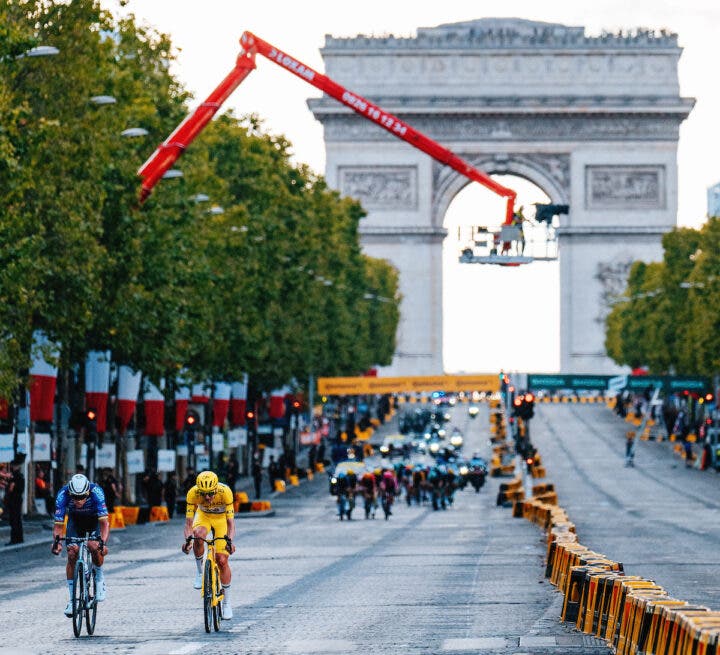
Mathieu van der Poel ended it on the cobbles of the Champs-Élysées, completely emptied by his winning move. The Dutch classics star slumped against the barriers after holding off a charging peloton in Paris.
Van der Poel and yellow jersey Tadej Pogačar had attacked over the final passage of Montmartre. They then tried to survive the long run back to the Tour’s most famous finishing straight.
The pursuit came close enough to turn the last kilometer into a full-blown chase scene. Van der Poel later said he expected to be caught and simply kept his head down.
Montmartre finale delivers a Paris showdown
The Tour’s revised Paris circuit again placed Rue Lepic at the center of the spectacle. Huge crowds packed Montmartre as the peloton raced three laps through the punchy, cobbled terrain.
ASO first moved away from the usual Champs-Élysées sprint template after the 2024 Paris Olympic Games showcased the same district. The change gave the Tour a finish shaped by attacks, not only sprint trains.
This year’s design also gave the fast men a chance. Organizers lengthened the run from the last climb to the Champs-Élysées enough for sprinters to reorganize behind late attackers.
That balance produced a finale with both suspense and prestige. Pogačar entered Paris on course for a record-tying fifth yellow jersey, yet still raced for the stage.
Van der Poel had focused on the day since leaving last year’s Tour before Paris. He said he had thought about the stage for a year while watching from home.
The final climb split the race open. Pogačar and Van der Poel, two of cycling’s most versatile riders, forced a gap as the peloton strained behind them.
Their advantage stood at 18 seconds after the hill. It fell to 11 seconds near the Arc de Triomphe, then to five seconds under the red kite.
Van der Poel then made one last acceleration with about 400 meters remaining. The move distanced Pogačar and gave him just enough road to reach the line first.
He threw his bike across the finish ahead of the sprinters, with Alpecin-Premier Tech teammate Jasper Philipsen leading the chase. Mads Pedersen crossed the line third.
Pedersen praised the spectacle after a finish decided by the smallest margins. He noted the impact of seeing the yellow jersey contest victory on the Champs-Élysées.
A new standard for the Tour’s last day
The traditional Paris sprint has long carried status, but it often followed a ceremonial approach to the capital. The Montmartre route has changed that rhythm.
Sunday’s stage felt closer to a one-day classic than a champagne-soaked finale. Riders such as Pedersen, Olav Kooij, and other surviving sprinters still had a route back into contention.
The risks remain clear. Pogačar negotiated traffic islands, cobbles, and tight Paris roads while already secure in yellow. That tension left UAE staff facing anxious final laps.
Yet the sight of Pogačar and Van der Poel racing without restraint gave the Tour a closing act worthy of its modern era. Van der Poel called the day incredible and paid respect to Pogačar.
After collapsing beyond the line, he needed minutes before he could properly absorb the win. The exhaustion matched the occasion.
The Tour de France now has a Paris ending that can reward sprinters, classics specialists, and general classification stars. Montmartre has given the race a finale people will debate, remember, and expect again.