

Tour de France heat has become an immediate concern, with temperatures forecast above 40 degrees Celsius during the race. Organisers are preparing for possible disruption, while the UCI has tightened checks on one common cooling tactic.

The opening team time trial in Barcelona already took place in mid-30s heat. Riders needed to manage body temperature carefully before a high-intensity effort, as Jonas Vingegaard led Visma-Lease a Bike to victory.
Tour de France heat increases focus on rider cooling
Teams used several pre-race methods to lower core temperature before the stage one start ramp. Ice socks have become one of the most visible tools in hot racing conditions.
The method usually involves filling a pair of tights with ice cubes and tying them together. Riders place the makeshift sock down the back of the neck, where melting ice cools clothing and skin.
However, several teams had to remove ice socks before starting the Barcelona team time trial. A UCI commissaire said the device “changes the morphology” of a rider’s shape, according to Cyclingnews.
The UCI pointed to article 1.3.032 of its technical regulations. That rule says clothing, accessories and other worn items may not modify a rider’s morphology.
Teams were told about the rule’s enforcement during equipment meetings before the Tour. The restriction applied during the opening team time trial.
The same enforcement was not obvious on stage two between Tarragona and Barcelona. Riders were seen using ice socks during the road stage, despite the earlier checks.
Teams turn to wider cooling strategies
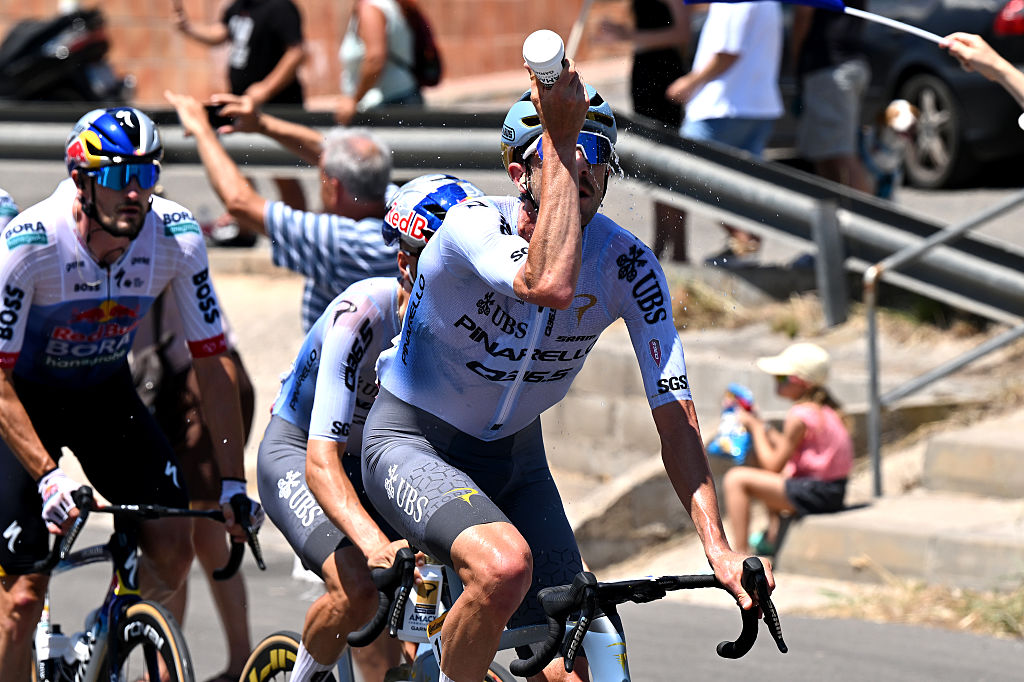
Heat management has become a major performance area in elite cycling. Teams now routinely use ice vests before racing, especially before time trials and hot road stages.
Riders also pour bidons over their heads during warm stages to reduce heat stress. Alpecin-Premier Tech riders received homemade ice pops while waiting before their opening team time trial.
Netcompany-Ineos tried another method before stage one. Riders placed both forearms in a plastic box of cool water before starting their ride.
Director of Racing Geraint Thomas said the approach aimed to keep core temperature down. He described it as a pre-cooling strategy before the team entered competition.
Thomas said the team had used the method on the track before. He added that riders also tried it during a circuit training session on Wednesday.
Netcompany-Ineos went on to finish narrowly second behind Visma-Lease a Bike in the team time trial.
Stage changes possible under extreme weather protocols
The heat forecast has created concerns beyond rider performance. Tour organisers are working under the UCI’s extreme weather protocols, which allow stages to be modified or cancelled.
Temperatures could reach as high as 44 degrees Celsius, according to a French Interior Ministry document viewed by Reuters. Regional officials may influence any decision to cancel stages.
The document said cancellation could happen in exceptional circumstances after consultation with organisers and relevant parties. Health, operational conditions, emergency services and public safety would all factor into decisions.
Wildfire risk has also become a concern in parts of southern France. Conditions were already severe before the race, following extreme temperatures in May and June.
A.S.O route designer Thierry Gouvenou told HLN the situation was a major concern. He said the soil was already “bone-dry” after earlier heat.
Organisers are expected to monitor the route day by day. The Tour now faces a dual challenge: protecting riders and spectators while preserving the sporting contest.